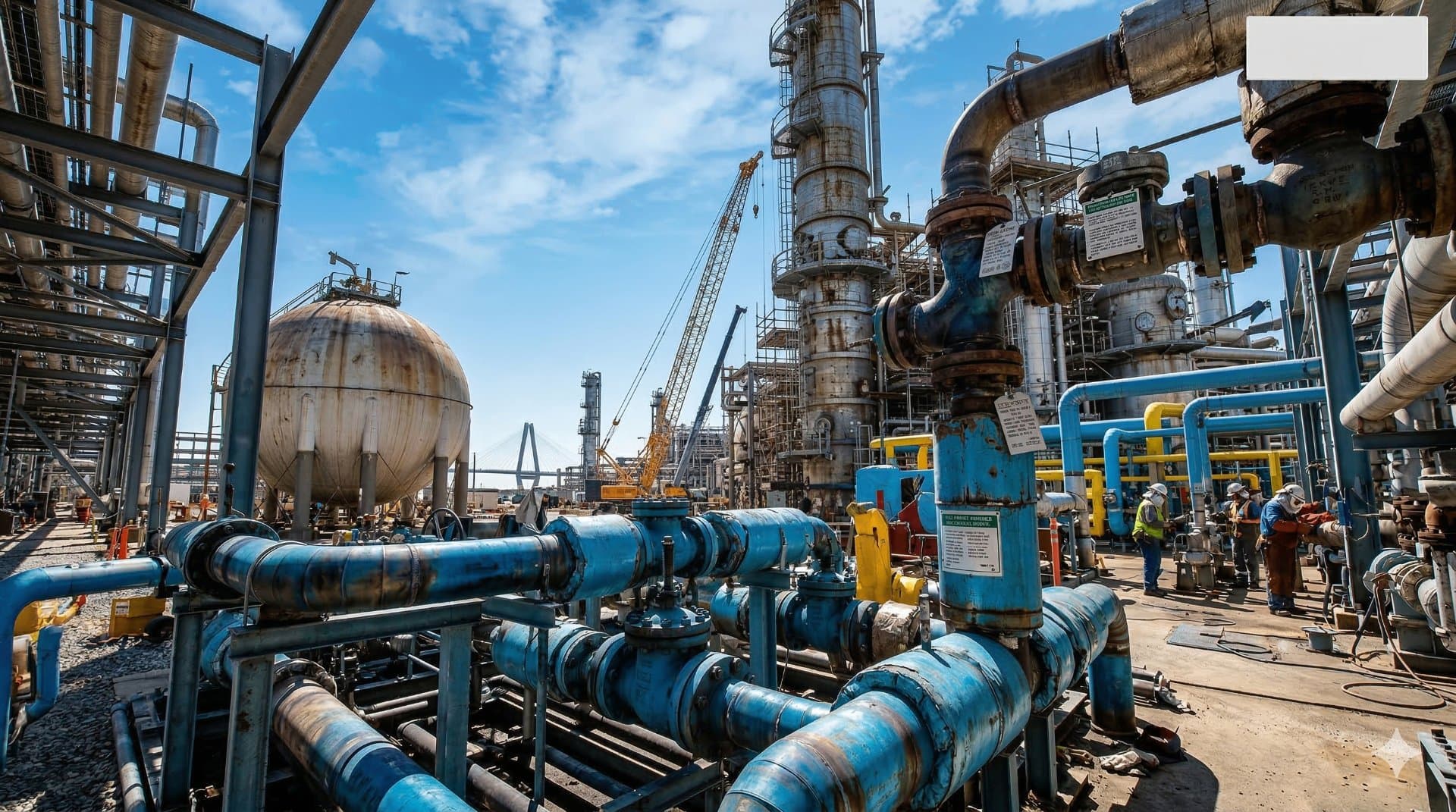
Instrument Installation Systems for Refineries & Petrochemical Plants
Snap Track cable tray, instrument stands, condensate chambers, and modular racks specified for corrosive environments, high process temperatures, and continuous operation demands.
THE ENVIRONMENT
The harshest instrumentation environment in industry.
Refineries and petrochemical plants represent the most demanding conditions for instrument installation hardware. Process temperatures range from cryogenic to superheated steam. Atmospheres contain hydrocarbon vapors, hydrogen sulfide, chlorides, and sulfur compounds that attack unprotected metals within months. Classified electrical areas — Class 1, Division 1 and Division 2 — govern cable management specifications across most of the process area. And the operational profile is continuous: most Gulf Coast refineries run 24/7 for three to five years between planned turnarounds, meaning the instrumentation installed during construction must perform without failure for years in conditions that would degrade inferior materials quickly.
TechLine Mfg. products have been installed in refineries, petrochemical plants, and chemical processing facilities across the Gulf Coast and internationally for over four decades. The company's Spanish Fort, Alabama manufacturing facility and La Porte, Texas regional service center support projects throughout the Gulf Coast corridor — the densest concentration of refinery and petrochemical capacity in North America.
CABLE ROUTING
Instrument cable routing from process tap to junction box.
The instrument cable routing challenge in a refinery is different from general industrial applications. The cable runs are typically shorter — most instrument loops route from a field device to a local junction box within 50–200 feet — but they are numerous, they pass through classified areas, and they carry signals that are sensitive to EMI and environmental damage.
Rigid conduit has historically been the default specification in refinery instrument cable routing. It provides the physical protection and environmental enclosure that classified area installations require. However, the total installed cost of a conduit-based instrument cable system is significantly higher than a properly specified cable tray system, and the operational flexibility of conduit — the ability to add cables, modify runs, and access circuits during turnarounds — is substantially lower.
Snap Track channel cable tray is increasingly specified by EPC contractors and refinery instrument engineers as the preferred system for instrument, control, and signal cable runs in Class 1, Division 2 areas and in unclassified process areas where cable protection is required but full conduit enclosure is not mandated. The UL classification of Snap Track under NEC Article 392 provides the code compliance foundation for these applications.
Why Snap Track is specified in refinery instrument cable routing:
- Marine-grade aluminum construction resists the hydrocarbon vapors, salt air, and atmospheric corrosives present in Gulf Coast refinery environments without the coating maintenance required by galvanized steel. The ABS Product Design Assessment qualifies Snap Track for offshore and marine environments — the same corrosive conditions found in coastal refineries.
- Support spans up to 18 feet reduce the number of hangers and supports required in pipe rack and instrument corridor installations. In a refinery instrument corridor with hundreds of parallel cable runs, the reduction in support hardware represents significant installed cost savings.
- Push-pin assembly system enables rapid installation by crews who may be more familiar with conduit. Field training takes under an hour, and TechLine's application engineers provide on-site support for every project purchase. On turnaround projects where schedule is the primary constraint, the installation speed advantage of Snap Track over bolted channel tray or conduit is measurable.
- Engineered fitting family — elbows from 3″ to 36″ radius, tees, crosses, waterfall fittings, and conduit adapters — eliminates field fabrication at direction changes and structural interferences. In a refinery where instrument corridors navigate around vessels, exchangers, and pipe racks, the ability to route cable cleanly without cutting and bending represents real labor savings and a cleaner, more maintainable installation.
FIELD DEVICE MOUNTING
Mounting pressure transmitters, analyzers, and field instruments.
Every instrument in a process plant needs a mount. The mounting hardware — instrument stands, modular racks, and fixed racks — is as critical to long-term performance as the instrument itself. An improperly mounted transmitter vibrates. A stand that corrodes loses its structural integrity. A rack that can't be reconfigured forces costly field modifications when the process changes.
Single instrument mounting
TechLine instrument stands are manufactured for pipe mount, floor mount, wall mount, and structural steel mounting in standard and custom configurations. Available in hot-dipped galvanized, 304 stainless steel, 316 stainless steel, and aluminum. Stock items ship within 24 hours. For refinery applications in corrosive atmospheres, 316 stainless steel stands are the standard specification.
Multiple instrument mounting — ModRack
When multiple transmitters, analyzers, or RIO cabinets need to be mounted in the same area, TechLine's ModRack provides a configurable off-the-shelf solution. The ModRack uses standard stanchions, adjustable receivers, and strut components that can be assembled in the field without cranes or heavy lifting. Available in galvanized, aluminum, 304SS, and 316SS. Direct burial option available for installations where the stanchions penetrate grade.
Large-scale permanent installations — FixedRack
For permanent installations requiring a fully-welded, custom-engineered structure, TechLine's FixedRack is built to customer drawings or specifications. Heavy duty and light duty options. Single or double sided. Optional weather protection roofing. Available in galvanized, aluminum, 304SS, 316SS, and painted finishes. FixedRack ships pre-assembled and ready to install, eliminating field fabrication of the support structure entirely.
PROCESS CONNECTION & PROTECTION
Condensate chambers and manifolds for refinery instrument loops.
The process connection between the main line and the instrument is where many instrument failures originate. Steam, condensate, corrosive vapors, and viscous process fluids that reach sensitive measurement instruments cause calibration drift, premature failure, and unplanned maintenance. Properly specified condensate chambers and seal pots protect instruments from these process conditions throughout the operational life of the facility.
Condensate Chambers and Seal Pots
TechLine condensate chambers are fabricated pressure vessels manufactured under ASME Section IX welding procedures and hydrotested per ASME Section VIII Division 1, UG-99. Every chamber ships with a pressure test certificate. X-ray and dye-penetrant testing are available on request.
Standard stock chambers: 3″ pipe, 12″ length, Schedule 80, 316 stainless steel or carbon steel, with ½″ FNPT connections. Standard stock ships immediately.
Carbon Steel
CS
General service, non-corrosive process
304 Stainless Steel
SS
Moderate corrosion resistance
316 Stainless Steel
316SS
High corrosion resistance, chloride environments
Chrome 11 (1.25Cr-0.5Mo)
P11
High temperature steam service
Chrome 22 (2.25Cr-1Mo)
P22
High temperature, high pressure steam
Chrome 91 (9Cr-1Mo-V)
P91
Advanced high temperature steam, power generation
Hastelloy
—
Severe corrosive service
Wall schedules from Standard (S/40) through Extra Extra Heavy. Pipe sizes 2″ through 6″ and larger. Seven port configurations available. The full TLDP part number system allows engineers to specify every parameter — pipe size, length, material, wall thickness, connection style, connection size, and port configuration — in a single part number.
Distribution Manifolds and Air Headers
TechLine air and steam distribution manifolds supply instrument air or purge gas to multiple instruments from a single source, simplifying the process connection infrastructure and reducing the number of individual connections to the main supply header. Manufactured to customer specifications in carbon steel, 304SS, and 316SS. Standard 5″ tap spacing. Threaded, socket weld, or flanged connections. Optional stainless steel ball valves on each outlet. Optional vent plug.
MATERIAL SELECTION
Corrosion is the primary long-term performance variable.
Gulf Coast refineries operate in one of the most corrosive atmospheric environments in North America. Salt air from the Gulf of Mexico, hydrogen sulfide from sour crude processing, sulfur dioxide from flue gas, and chloride compounds from cooling tower drift create an atmospheric corrosion load that is significantly higher than inland industrial facilities.
Aluminum
Marine-grade aluminum (6063-T6, as used in Snap Track) forms a stable oxide layer that resists further corrosion in salt and hydrocarbon atmospheres. No coating maintenance required. Preferred for cable tray and support structures in exposed process areas. Lighter than galvanized steel, which reduces support loading.
316 Stainless Steel
The standard specification for instrument stands, condensate chambers, and connection hardware in process areas with acid exposure, chloride compounds, or high-temperature service. The molybdenum content of 316SS provides substantially better pitting corrosion resistance than 304SS in chloride environments.
Hot-dipped galvanized
Acceptable for cable tray support structures and racks in non-process areas and in environments with moderate atmospheric corrosion. Coating will degrade over time in severe environments. Maintenance recoating required on long-term installations.
Carbon steel
Acceptable for condensate chambers and manifolds in non-corrosive process service. Not recommended for atmospheric exposure in Gulf Coast environments without protective coating.
TURNAROUND APPLICATIONS
Snap Track on turnaround and brownfield projects.
Refinery turnarounds represent a specific and growing application for Snap Track. During a planned turnaround — where a process unit is shut down for inspection, maintenance, and modification — instrument cable work is compressed into a tight schedule window where installation speed is the primary constraint.
Snap Track's push-pin assembly system installs 33–48% faster than bolted channel tray and significantly faster than conduit, based on man-hour data from EPC contractors who have completed projects with all three systems. On a turnaround where instrument crews are working on compressed schedules, that installation speed translates directly to schedule recovery or reduced overtime cost.
The reconfigurability of Snap Track is equally valuable in brownfield environments. Existing Snap Track runs can be extended by snapping in new sections. Direction changes can be added by snapping in a fitting. Existing fittings can be removed and reused elsewhere. In a brownfield refinery environment where the instrument infrastructure evolves with the process, the ability to modify cable routing without cutting or replacing hardware has long-term maintenance value.
PROJECT CAPABILITIES
TechLine's Gulf Coast project capabilities.
TechLine Mfg. manufactures instrument installation hardware for projects ranging from individual instrument loop retrofits to large-scale EPC projects supplying instrument and electrical bulk packages for new unit construction.
- Standard stock items ship within 24 hours from Spanish Fort, AL and La Porte, TX
- Condensate chambers: standard stock available immediately, non-standard expedited delivery available
- Instrument stands: large inventory of standard heights and configurations
- ModRack: off-the-shelf, configured from published part number system
- FixedRack: fully-welded custom racks built to customer drawings, any quantity from one to hundreds
- Distribution manifolds: custom fabricated to customer specifications
- Field training: on-site Snap Track installation training included with project purchase
- Regional service: TechLine's La Porte, Texas regional service center supports Gulf Coast refinery and petrochemical projects directly. La Porte is located adjacent to the Houston Ship Channel, at the center of the largest concentration of refinery and petrochemical capacity in North America.