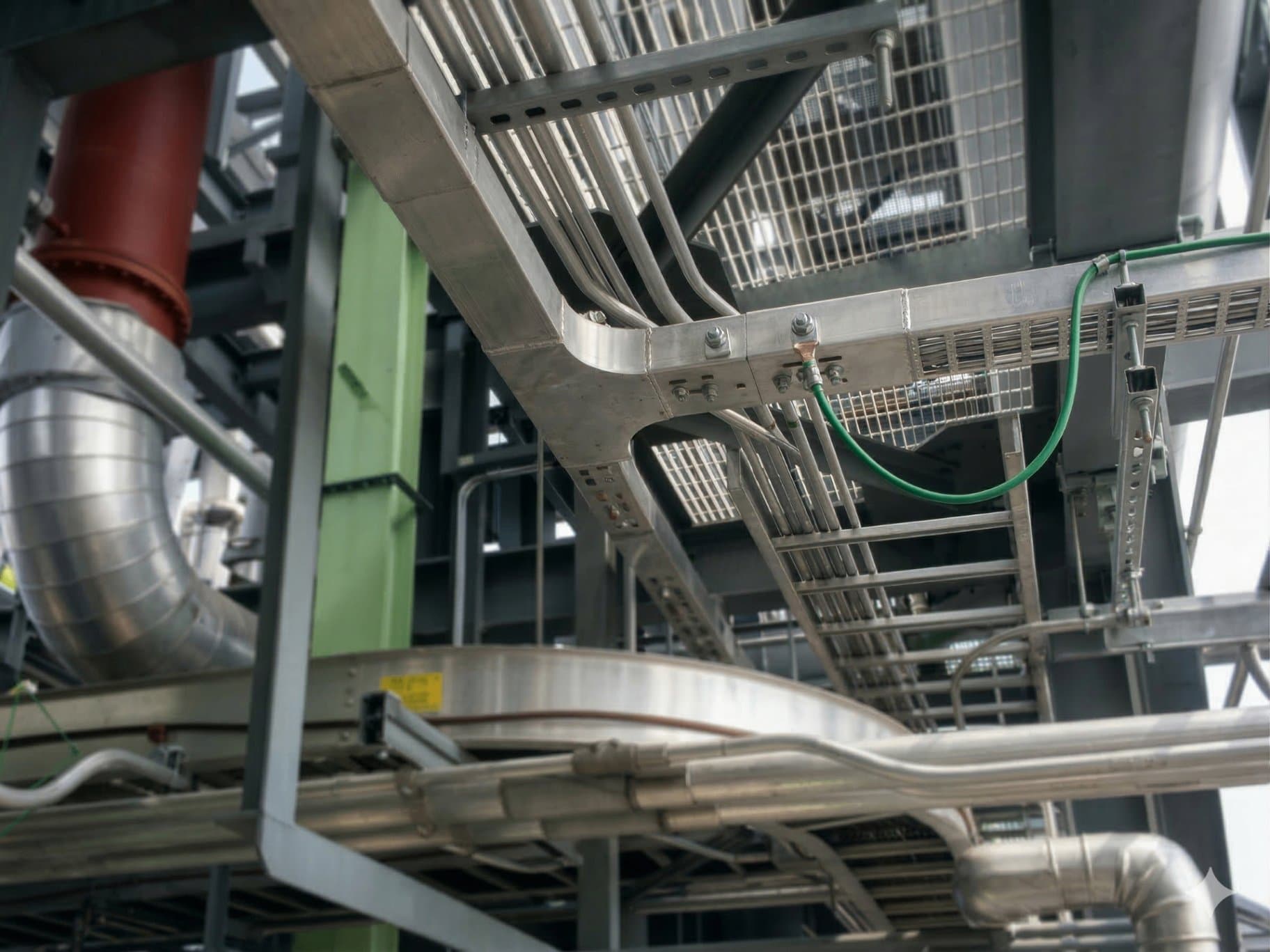
Instrument Cable Routing in Process Plants
Conduit, wire basket, or channel tray — how engineers choose the right cable management system for instrument, control, and signal cable in refineries, LNG facilities, and power plants.
THE CHALLENGE
The routing decision that affects every instrument loop on the project.
Every instrument in a process plant needs a cable path — from the field device to the junction box, from the junction box to the marshalling cabinet, from the marshalling cabinet to the control room. In a refinery or LNG facility, that means thousands of individual cable runs through some of the harshest industrial environments on earth: corrosive atmospheres, extreme temperatures, constant vibration, and the ever-present risk of physical damage from maintenance activity.
The engineer specifying that cable management system faces three primary options: rigid metal conduit, wire basket tray, or channel cable tray. For instrument, control, and signal cable routing in process plants, channel cable tray — specifically Snap Track — is the specification that delivers the lowest installed cost, the fastest installation, and the most complete code compliance documentation. This page provides the technical framework that supports that specification decision.
THE THREE OPTIONS
Conduit, wire basket, and channel tray — what each one actually does.
Rigid Metal Conduit (RMC)
Rigid conduit has been the default cable management system in industrial facilities since the early twentieth century. It provides maximum physical protection, complete environmental enclosure, and a well-understood installation process that electricians learn during their apprenticeships. Where conduit is specified, every circuit has a defined, protected path that is physically isolated from every other circuit.
The limitations are cost, labor, and flexibility. Conduit requires skilled labor to cut, thread, bend, and pull. Every direction change requires a fitting. Every circuit requires its own run or a carefully calculated conduit fill. Revisions — which are constant in process plant construction — require additional conduit runs, additional pull boxes, and additional labor. In a large process plant, conduit costs compound quickly.
These limitations — high labor cost, inflexible routing, and difficult post-construction modification — are the reasons process plant engineers have increasingly moved to channel cable tray for instrument cable routing. The cost data from documented installations consistently shows conduit at 2–3x the total installed cost of channel tray on comparable runs.
Wire Basket / Wire Mesh Tray
Wire basket became popular in the 1990s as the telecom and data cabling industry needed a fast, flexible, low-cost cable management solution for structured cabling in commercial buildings. It does that job well. For data centers, office buildings, and light commercial applications carrying IT cabling, wire basket is a legitimate and cost-effective system.
Its adoption in process plant instrumentation applications, however, has created documented problems that show up repeatedly in engineer forums, AHJ inspections, and field maintenance reports.
Sharp edges and NEC compliance.When wire basket is field-cut to fit — which is nearly always, since installers buy straight sections and fabricate everything else — the cut ends create sharp edges that violate NEC 392.5 requirements and create real cable jacket damage risk. Inspectors on Mike Holt's forum and other industry forums have documented instances where AHJs consider field-cut basket installs clear code violations, though enforcement varies.
Structural ambiguity. Wire basket is not manufactured to the same structural standards as engineered cable tray. NEMA VE-2 load and span requirements for channel tray do not apply to wire basket, and many basket products have no published load data or span ratings.
Field fabrication dependency. Because wire basket fittings are either unavailable or prohibitively expensive, most basket installations rely entirely on field fabrication for direction changes and elevation transitions — a process that is time-consuming, produces inconsistent results, and generates the sharp edges described above.
For instrument and control cable in process plant environments, wire basket is a marginal specification — and the evidence from field practice, AHJ inspections, and engineering forums consistently supports this conclusion.
Channel Cable Tray
Channel cable tray — including Snap Track — occupies the middle ground between conduit and wire basket. It provides the open, accessible cable path of tray with more structural integrity, better cable protection, and more complete code compliance than wire basket.
The key technical distinction from wire basket is that engineered channel tray is manufactured to published structural standards, carries documented load and span ratings, provides a pre-engineered fitting family that eliminates field fabrication, and ships as a complete UL-classified system.
Snap Track specifically adds the push-pin assembly system, 20-foot extruded sections with support spans up to 18 feet, and an ABS Product Design Assessment that qualifies it for marine and offshore applications.
COMPARISON
How the three systems compare — a technical reference for instrument engineers.
Physical cable protection
Conduit
Maximum — full enclosure
Wire Basket
Minimal — open grid
Snap Track
Good — solid side rails, ventilated bottom
Installed cost vs. conduit
Conduit
Baseline
Wire Basket
20–40% lower
Snap Track
50–68% lower (TechLine documented study)
Labor hours per foot
Conduit
0.40–0.48 MH/ft
Wire Basket
Not standardized
Snap Track
0.18 MH/ft
Support span
Conduit
10 ft max (NEC 344)
Wire Basket
3–5 ft typical
Snap Track
Up to 18 ft depending on load
Field fabrication required
Conduit
Moderate (bending)
Wire Basket
Extensive (all fittings)
Snap Track
Minimal (engineered fitting family)
Future reconfigurability
Conduit
Low — new conduit run required
Wire Basket
Moderate — cable can be added
Snap Track
High — snap fittings, open access
NEC code compliance
Conduit
Clear — Article 344
Wire Basket
Ambiguous — sharp edges, AHJ variation
Snap Track
Clear — Article 392, UL Classified
Moisture accumulation risk
Conduit
High — condensation traps
Wire Basket
Low — open, self-draining
Snap Track
Low — ventilated, self-draining
EMI isolation
Conduit
Excellent — metallic enclosure
Wire Basket
Poor — open grid
Snap Track
Good — solid side rails
Corrosion resistance
Conduit
Dependent on material/coating
Wire Basket
Dependent on finish
Snap Track
Marine-grade aluminum standard
AHJ acceptance
Conduit
Universal
Wire Basket
Variable — sharp edges flagged
Snap Track
High — UL Classified
Typical application
Conduit
Classified areas, high-traffic zones
Wire Basket
IT/data cabling, light commercial
Snap Track
Instrument, control, signal cable
Labor data source: TechLine Mfg. Cost Savings Potential Comparison, Rev. 3, 2017. Man-hour rates sourced from EPC contractor input, US Gulf Coast region.
SELECTION GUIDE
A practical selection framework for process plant cable routing.
For instrument, control, and signal cable in process plant environments, channel cable tray delivers the lowest installed cost, the fastest installation, and the most complete NEC compliance path.
Specify Snap Track channel tray when:
The run carries instrument cable (ITC, PLTC, TC-rated), control cable, or signal cable in a process plant environment
The run transitions from a main ladder tray to a field device or junction box — the "last mile" of the instrument loop
The installation environment is coastal, marine, or chemically active — applications where marine-grade aluminum outperforms galvanized steel basket
The project requires documented load data, published span ratings, and UL classification for AHJ approval
Future reconfigurability is important — turnaround projects, facilities with frequent process modifications
The contractor needs to train a crew quickly — push-pin assembly brings a crew to full speed in under an hour
COST ANALYSIS
The numbers behind the specification decision.
TechLine Mfg. conducted a side-by-side cost analysis of a Class 1, Division 2 process plant installation, converting a typical conduit wiring system to Snap Track. The results:
Conduit
1,400 LF, mixed 1"–2" RGC
Snap Track
480 LF, 2"–6" channel
Source: TechLine Mfg. Cost Savings Potential Comparison, Rev. 3, 2017. Labor rate: $60/hr all-in, US Gulf Coast. Snap Track at 18-foot span.
The labor differential is the dominant factor. Conduit requires 0.27–0.56 man-hours per foot depending on size. Snap Track runs 0.18–0.35 man-hours per foot. On a project with 50,000 feet of instrument cable runs, that gap represents hundreds of thousands of dollars in labor savings.
Channel tray also requires fewer components than conduit — no pull boxes, no junction boxes at direction changes, no individual conduit seals. The procurement, receiving, storing, and installing of those components carries a cost that rarely appears in simple material comparisons but is real and significant on large projects.
The Snap Track Advisor tool calculates installed cost for specific project parameters — cable count, run length, material, and support spacing — so engineers can document the cost case in specification packages and design review presentations.
MATERIAL SELECTION
Matching the cable tray material to the process environment.
The process plant environment determines material selection as much as the application does. Snap Track is available in marine-grade aluminum as standard, with other materials available for specific requirements.
Standard indoor industrial
Aluminum
Lightweight, corrosion-resistant, cost-effective
Coastal, marine, offshore
Aluminum
ABS PDA certified, proven in salt atmosphere
Petrochemical, acid exposure
316 Stainless Steel
Maximum chemical resistance
LNG, cryogenic service
Consult TechLine
Material selection depends on specific service temperature
Standard outdoor, non-corrosive
Galvanized or Aluminum
Both acceptable; aluminum preferred for long-term performance
CODE COMPLIANCE
Code compliance for instrument cable in channel tray.
Engineers specifying channel cable tray for process plant instrument cable need to understand NEC Article 392 and the specific fill capacity calculations it requires.
NEC Article 392 — Cable Tray Systems governs the installation of cable tray, including ventilated channel tray. Key requirements for instrument cable applications:
Fill capacity (NEC 392.22):For multi-conductor cables rated 2000V or less in ventilated channel tray, the allowable fill is governed by NEC Table 392.22(A)(5) for 4" and 6" trays. For 2" tray, TechLine follows the more conservative NEC Table 392.22(A)(6).
2"
0.80 in²
4"
2.5 in²
6"
3.8 in²
Ampacity (NEC 392.80): Cable spacing and ampacity requirements apply when power cables are installed in tray. For instrument and signal cables, ampacity is generally not the limiting factor.
Equipment grounding:Cable tray must maintain electrical continuity. Snap Track's continuous hole pattern allows a single bonding jumper on mechanically discontinuous installations — no drilling required.
Applicable cable types for tray: TC (Tray Cable), ITC (Instrumentation Tray Cable), ITC-ER, TC-ER, PLTC-ER. The -ER suffix denotes exposed run rating, suitable for use outside of tray where it enters and exits the system.
Standards: NEMA BI-50015-2024, IEC 61537, NEC 2017 Article 392, ABS PDA (Snap Track).