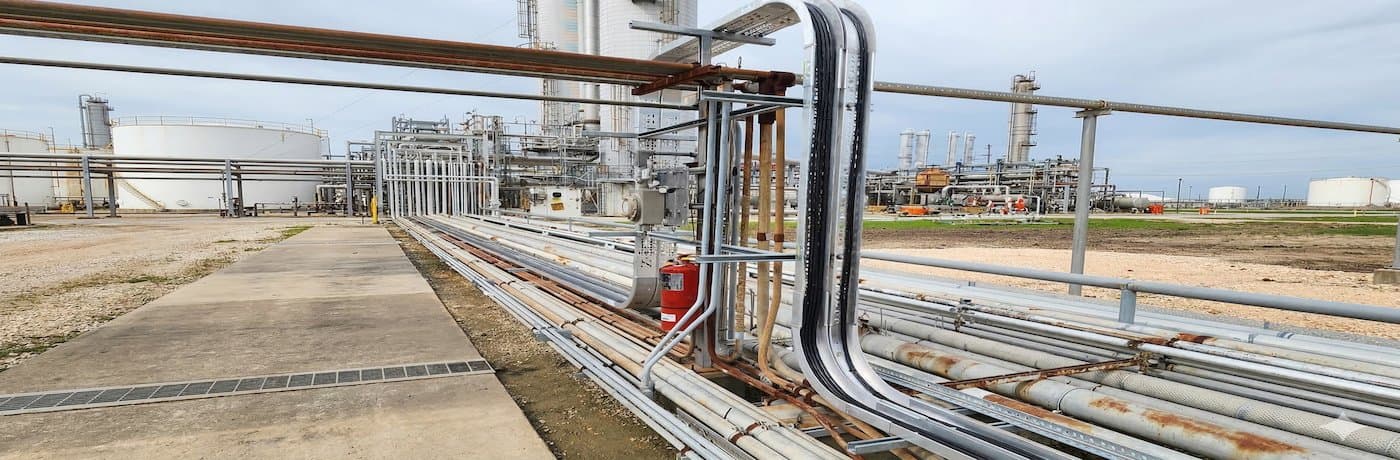
Snap Track Cable Tray System
UL Classified channel cable tray for instrument, control, and signal cable routing in refineries, LNG facilities, and process plants. Marine-grade aluminum. Push-pin assembly. Published load data.
2", 4", 6"
Available Widths
18' Max Span
Support Spacing
UL Classified
NEC Article 392
ABS PDA
Marine & Offshore
APPLICATION
The instrument cable routing system designed for process plants.
Snap Track is an extruded aluminum channel cable tray system developed specifically for instrument and control cable routing in refineries, LNG facilities, power plants, and petrochemical installations. It occupies the application space between rigid conduit — which is expensive, labor-intensive, and inflexible — and wire basket tray, which lacks the structural standards, NEC compliance path, and environmental durability that process plant applications require.
The system consists of 20-foot extruded aluminum tray sections with a U-channel profile, a pre-engineered fitting family covering every standard direction change, and a push-pin assembly method that eliminates tools and reduces installation to a crew skill set achievable in under an hour of training. Support spans of up to 18 feet reduce the number of hangers and supports required compared to conduit systems, which must be supported every 10 feet per NEC 344.
TechLine has shipped Snap Track to Gulf Coast refineries, LNG terminals, offshore platforms, and industrial facilities across North America. The system carries a UL Classification for NEC Article 392 compliance and an ABS Product Design Assessment for marine and offshore service — the only instrument channel cable tray system with both certifications.
ASSEMBLY SYSTEM
Push-pin assembly. No tools required.
Standard cable tray systems require bolted connections at every splice and fitting — tools, hardware, and labor time at every joint. Snap Track uses a push-pin assembly system: sections and fittings connect with a push-pin fastener that seats without tools in a single motion. The connection is mechanical, maintains structural continuity, and satisfies NEC equipment grounding requirements without additional bonding hardware on continuous runs.
On a large process plant instrument installation with hundreds of tray sections and dozens of direction changes, the labor difference accumulates quickly. TechLine-documented cost studies show Snap Track installation at 0.18 man-hours per foot against conduit at 0.40–0.56 man-hours per foot depending on conduit size. At a Gulf Coast labor rate of $60/hour all-in, a 480-foot Snap Track installation in a documented study cost $14,683 installed — versus $45,493 for the equivalent conduit run.
A trained crew reaches full installation speed in under one hour. No specialized conduit-bending skills are required. The system can be installed by instrument fitters without a licensed electrician for the tray-hanging portion of the work, which affects crew composition and cost on IBEW-staffed projects.
LOAD DATA
Load data and NEC fill capacity.
Snap Track is manufactured and tested to NEMA BI-50015-2024. Published load tables are available in the downloadable specification sheets below. Key values for specification purposes:
NEC 392 Cable Fill Capacity
For multi-conductor cables rated 2000V or less in ventilated channel tray per NEC 392.22. 2" tray per Table 392.22(A)(6); 4" and 6" per Table 392.22(A)(5).
2"
0.80 in²
8–12 cables
4"
2.5 in²
25–35 cables
6"
3.8 in²
38–52 cables
*Typical count for ½" OD ITC cable. Actual count depends on cable OD — calculate fill per NEC 392.22 for your specific cable mix.
Support Spans
Snap Track supports spans up to 18 feet at published load ratings — compared to 10 feet maximum for ¾"–1" RMC per NEC 344. Fewer supports per linear foot of run reduces hanger hardware, installation labor, and structural steel requirements.
All widths (2", 4", 6")
Up to 18' span
Standard section length: 20'. Actual span rating varies by load — consult published NEMA BI-50015-2024 load tables or contact TechLine for project-specific confirmation.
FITTING FAMILY
Pre-engineered fittings. No field fabrication.
Every direction change, elevation transition, branch, and reduction in a Snap Track installation is served by a pre-engineered fitting. No cutting and bending straight sections to make fittings — a practice that creates sharp edges, violates NEC 392.5, and produces non-structural connections. The TechLine fitting family covers the complete range of conditions in a process plant instrument installation.
Horizontal Elbows
90° and 45° horizontal turns. Pre-engineered to match tray width. No field fabrication required at direction changes.
Vertical Elbows
Outside and inside vertical turns for elevation changes. Available in 90° and 45°. Maintains structural continuity through the transition.
Tees
Horizontal tee fittings for branching from a main run to a branch run. Reduces to smaller tray width where the branch count drops.
Reducers
Inline reducers that step down from a larger tray width to a smaller one as cable counts decrease along a run. Eliminates offset cuts and field fabrication.
Covers
Solid snap-on covers for runs that pass through areas requiring additional cable protection. Available in lengths matching tray sections.
Splice Plates
Structural connection between tray sections. Maintains NEC equipment grounding continuity without requiring a separate bonding jumper on continuous runs.
Hangers and Support Hardware
Pre-engineered hanger assemblies for ceiling mount, wall mount, and strut mount installations. Reduces field engineering on support design.
MATERIAL SELECTION
Marine-grade aluminum is the standard. Match to your environment.
Marine-grade aluminum is the standard material for Snap Track — corrosion-resistant, lightweight, and the correct specification for the coastal and chemical environments where most Gulf Coast instrumentation is installed.
Standard indoor industrial
Aluminum
Coastal, Gulf Coast outdoor
Aluminum (ABS PDA rated for marine service)
Offshore platform, marine
Aluminum (ABS PDA)
Petrochemical, acid atmosphere
316 Stainless Steel
LNG, cryogenic service proximity
Consult TechLine — service temp dependent
Standard outdoor, non-corrosive
Aluminum or Galvanized
316SS available for chemical process areas. Contact TechLine for non-standard material requirements or cryogenic service applications.
CERTIFICATIONS & STANDARDS
The only instrument channel tray with UL Classification and ABS PDA.
UL Classification
NEC Article 392 compliance for use as a cable tray system in electrical installations. Required for AHJ acceptance on most industrial projects.
ABS Product Design Assessment
American Bureau of Shipping product design review qualifying Snap Track for marine and offshore service. Required for offshore platform and marine vessel installations.
NEMA BI-50015-2024
Manufactured and tested to the current NEMA standard for metal cable tray systems. Published load data and span ratings per this standard.
NEC Article 392
Cable Tray Systems. Snap Track's UL Classification provides the compliance pathway for NEC Article 392 wiring method requirements, including fill, grounding, and support spacing.
Downloads
REFERENCE ARTICLE
Cable Tray vs Conduit: Full Cost Comparison
Side-by-side installed cost data from a documented 480-foot Gulf Coast installation. Labor rates, material costs, support counts, and when conduit still makes sense.
Read the full comparison