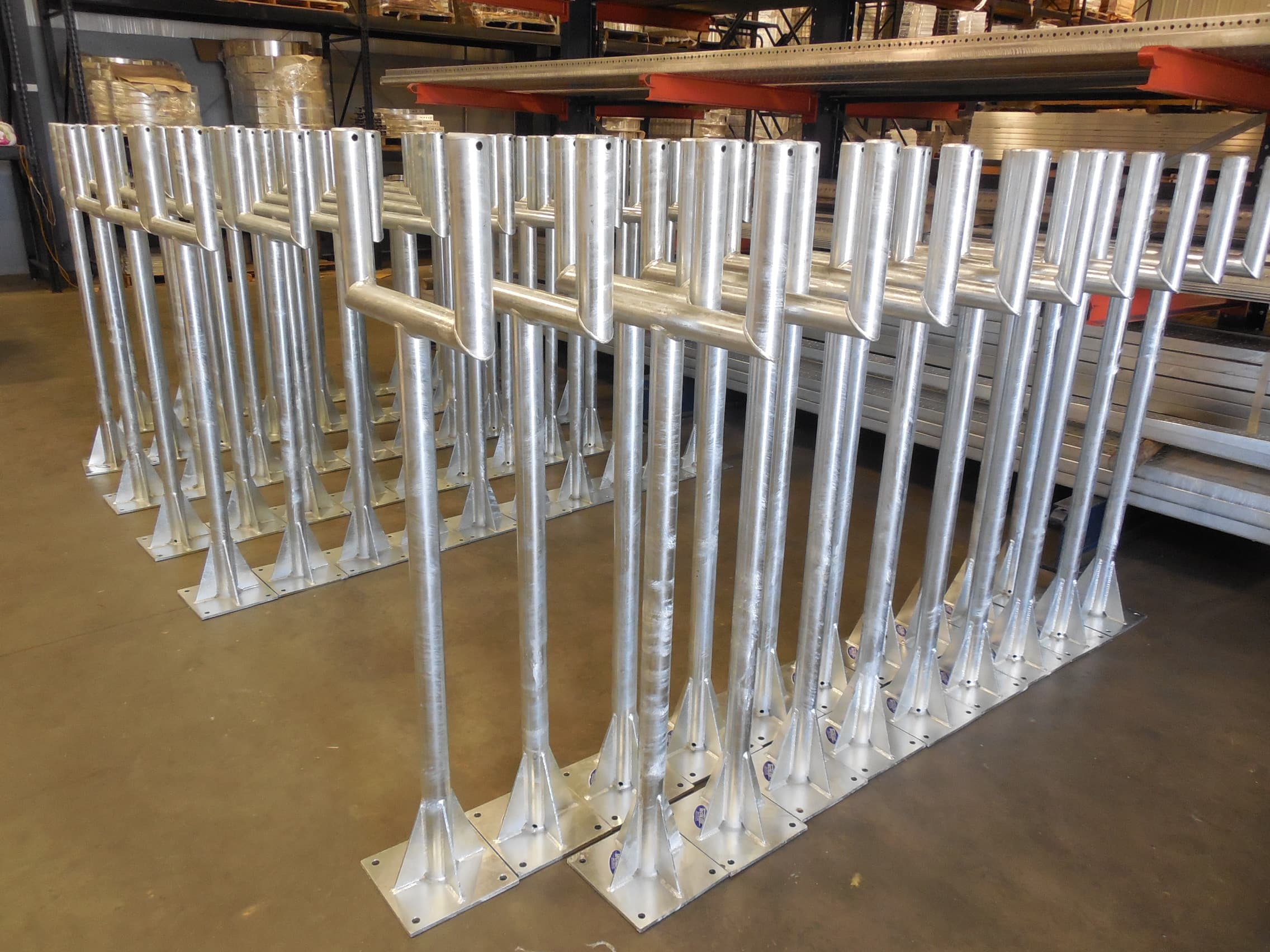
Instrument Stand Selection Guide
How to select the right instrument stand for your application. Mount type, material, horn configuration, and stock availability — organized by the decisions you actually need to make.
7
Mount Types
4
Material Options
24 hrs
Stock Shipping
1–4
Horn Configurations
STEP 1
Select mount type based on what the stand attaches to.
The first decision is structural: what is the stand mounting to? The answer determines the mount type. Everything else — material, height, horn count — flows from this choice.
Pipe Mount
When: Instrument mounts directly to process piping or pipe rack structure. The most common configuration in process plant instrumentation.
How: U-bolt or pipe clamp attaches to 2" process pipe. Positions the instrument at the correct elevation and orientation relative to the process connection.
Single and double horn configurations.
Floor Mount
When: Instrument is not near pipe and needs a freestanding support on concrete grade or structural steel deck.
How: Bolted base plate to concrete or steel. Available in single, double, triple, and quad horn configurations for consolidating multiple instruments.
Single through quad horn.
Wall Mount
When: Floor space is limited or the instrument needs to be adjacent to a vessel wall, structural steel, or concrete surface.
How: Bracket attaches to wall surface. Positions instrument perpendicular to mounting surface.
Single and double horn.
Beam Mount
When: Instrument is at an elevated location where the stand clamps to overhead structural steel rather than mounting to floor or pipe.
How: Beam clamp attaches directly to structural steel beams or channels.
Single horn typical.
Grating Mount
When: Instrument is on an elevated deck with open bar grating — common in refinery and chemical plant elevated platforms.
How: Penetrates grating using grating fasteners. No concrete foundation required.
Single and double horn.
U-Bolt Mount
When: Mounting to pipe rack structure or process piping of various diameters where the stand wraps around the pipe.
How: U-bolt clamps around pipe of varying ODs. Accommodates a range of pipe diameters at the mounting point.
Single horn typical.
Cable Mount
When: Instrument is adjacent to cable tray runs and can be supported from the tray support system.
How: Mounts directly to cable tray structure. Eliminates the need for a separate stand foundation.
Single horn.
Two additional specialty configurations: Capillary Spool and Mounting Flag for remote seal transmitters where the capillary tube requires a controlled routing path, and Tech-Mount Modularfor custom configurations that don't fit standard options — modular components allow custom heights and horn arrangements without full custom fabrication lead time.
STEP 2
Select material based on the environment.
The environment around the instrument — not the process fluid inside the pipe — determines the stand material. The stand is structural support, not a wetted component. Match the material to the ambient exposure the stand will see over its service life.
Standard outdoor industrial
Hot-dip galvanized steel
Cost-effective corrosion protection for most outdoor environments. ASTM A-123 coating.
Coastal, Gulf Coast outdoor
316 stainless steel
Required for salt air, chemical vapor, and coastal environments. Standard spec on most Gulf Coast projects.
Indoor, non-corrosive
Galvanized steel or aluminum
Either material works. Galvanized is lower cost. Aluminum is lighter for overhead locations.
Petrochemical, acid atmosphere
316 stainless steel
Resist chloride stress corrosion and acid vapor attack.
Offshore platform, marine
316 stainless steel
Marine environment requires full stainless construction. Match to platform material spec.
Cryogenic service proximity
304 or 316 stainless steel
Austenitic stainless maintains ductility at cryogenic temperatures. Carbon steel becomes brittle below -20°F.
Food, pharma, sanitary
316L stainless steel
Low-carbon grade for weldability and corrosion resistance in washdown environments.
STEP 3
Stock vs custom: what ships now and what needs lead time.
TechLine stocks standard configurations in galvanized steel and 316 stainless steel at the Spanish Fort, Alabama facility. Stock items ship in 24 hours. Custom configurations — non-standard heights, specialty materials, unusual horn arrangements — are manufactured to order.
Standard pipe mount, single/double horn, galvanized or 316SS
Standard floor mount, single/double horn, galvanized or 316SS
Triple or quad horn floor mount
Non-standard height or horn arrangement
Specialty material (Hastelloy, Monel, duplex SS)
Tech-Mount modular configuration
COMMON MISTAKES
Three specification errors that cost time in the field.
Wrong material for the environment
Specifying galvanized steel in a coastal or petrochemical environment. The galvanized coating breaks down in salt air and acid vapor within 2–5 years. If the project is on the Gulf Coast, within 10 miles of the coast, or in a chemical plant atmosphere — specify 316SS. The material upgrade is a fraction of the cost of replacing corroded stands during a turnaround.
Specifying custom when stock will work
Custom stands require 5–10 business days vs 24 hours for stock. If the stand is a standard pipe mount or floor mount in a common height, it's almost certainly in stock. Check stock availability before writing a custom spec — it can save weeks on procurement.
Single horn stands where double horn saves money
Two single horn stands side by side cost more than one double horn stand — both in material and installation labor. If two instruments share the same process tap or are within 12 inches of each other, specify a double horn. The consolidation saves one stand, one set of mounting hardware, and one installation cycle.
FREQUENTLY ASKED QUESTIONS
Instrument stand selection: common questions.
What types of instrument stands are available for process plants?
Seven primary mount types: pipe mount (most common), floor mount, wall mount, beam mount, grating mount, U-bolt mount, and cable mount. Each is available in single or multiple horn configurations. Specialty options include capillary spool/mounting flag for remote seal transmitters and Tech-Mount modular for custom configurations.
What material should I specify for instrument stands?
Hot-dip galvanized steel for standard outdoor industrial environments. 316 stainless steel for coastal, Gulf Coast, petrochemical, offshore, or any chloride/acid environment. Aluminum for lightweight indoor applications. The material should match the ambient environment the stand is exposed to, not the process fluid.
How fast do instrument stands ship?
Stock stands (standard pipe mount and floor mount in galvanized or 316SS) ship in 24 hours from TechLine's Spanish Fort, Alabama facility. Custom configurations ship in 5–10 business days. Tech-Mount modular ships in 3–5 business days.
What is the difference between a single horn and double horn instrument stand?
A single horn supports one instrument. A double horn supports two instruments side by side on the same structure. Use double horn when two instruments share a process connection or are within 12 inches of each other — it eliminates a second stand and reduces installation labor.
Related Pages
Instrument Stands
Full product page with all configurations.
ViewField Device Mounting
How stands fit into complete instrument installations.
ViewInstrument Stand Configurator
Interactive tool — build a stand and get a part number.
ViewModRack Modular Instrument Rack
For multi-instrument mounting applications.
ViewFixedRack Custom Racks
Welded custom racks for large equipment.
ViewComplete Instrument Loops
How every TechLine component works together.
View