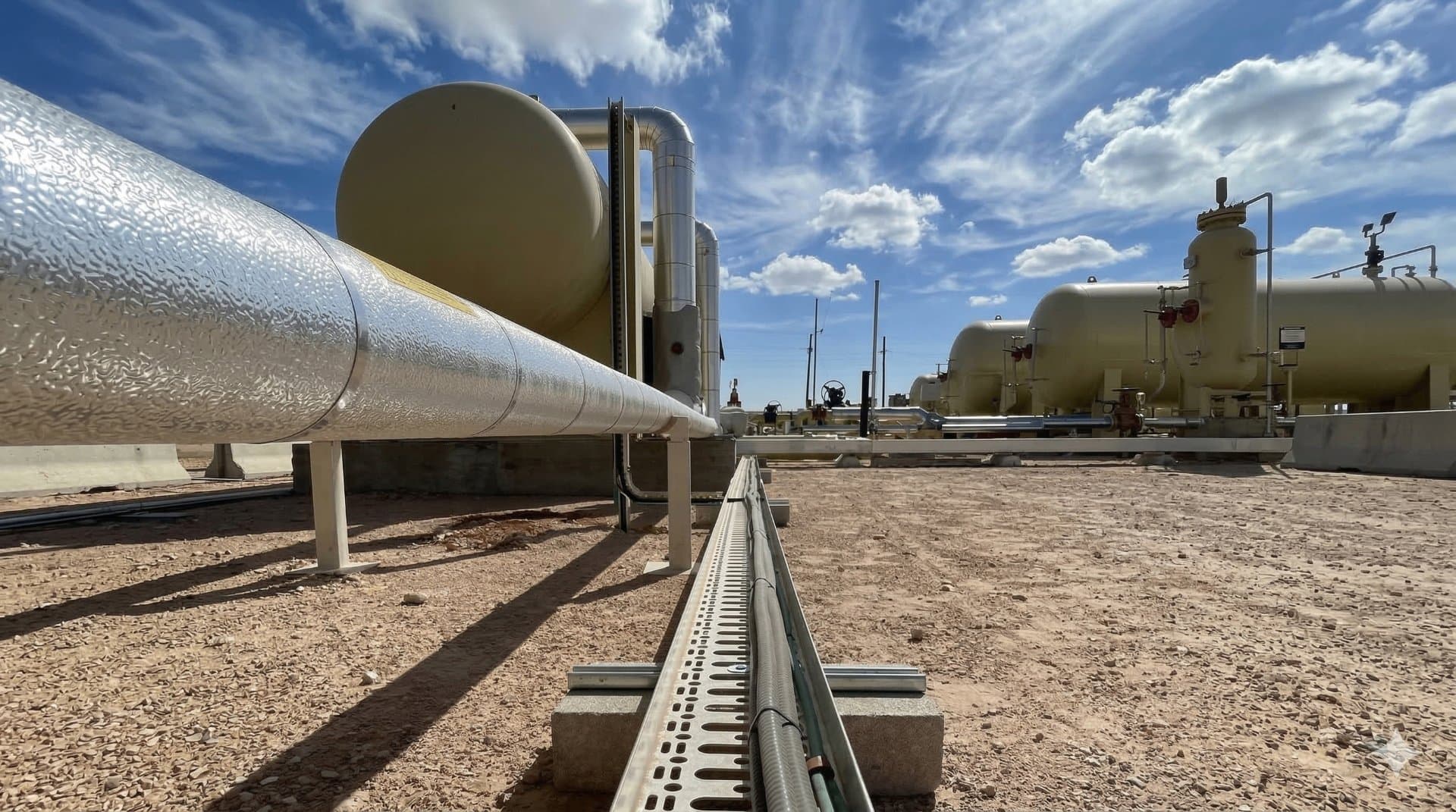
Angle Tray & Channel for Instrument Tubing Support
Perforated angle tray, channel, and flat bar for instrument tubing, impulse lines, and secondary cable. Aluminum, hot-dipped galvanized, and stainless steel — with a full set of factory fittings.
2", 3", 4", 6"
Available Widths
20' Sections
Standard Length
Aluminum, HDG, SS
Materials
UL Classification
Available on Request
OVERVIEW
Angle tray is the structural backbone of an instrument installation.
Angle tray carries impulse tubing, small-bore instrument piping, and secondary cable runs from the process connection to the instrument enclosure — the work that cable tray wasn't designed for. TechLine manufactures perforated angle, channel, and flat bar in aluminum, hot-dipped galvanized steel, and 304 stainless steel, with 316 stainless available on request. Every profile is paired with a full set of factory fittings — splices, elbows, tees, and crosses — so direction changes happen in the shop, not the field. The 2" sidewall channel line is UL Classified (File E249472).
What is angle tray?
Angle tray is a perforated L-shaped structural support used to route instrument tubing, impulse lines, and secondary cable in industrial plants. Unlike cable tray, which is sized for high-volume electrical runs, angle tray is sized for small-bore tubing (typically 1/4" to 1" OD) and is perforated so tubing can be clamped directly to the tray at any point along the span. It appears in every process plant that has a field instrument — oil and gas, LNG, petrochemical, power generation, and refining.
Angle, channel, and flat bar — when to use each
The three profiles solve three different mounting problems.
Angle (L-profile)
Single-sided mounting. Use when tubing runs one direction along a pipe rack or wall and you need easy lateral access. Most common profile in petrochemical and oil & gas installations.
Channel (U-profile with solid side rails)
Two-sided containment. Use when tubing needs lateral support on both sides — multi-run bundles, long unsupported spans, or areas with vibration.
Flat bar
Wall or structure-mounted. Use for close-to-surface runs where an angle or channel profile would be oversized, or for retrofit work where clearance is tight.
All three profiles have alternating 9/16" round and 5/16" × 1-1/4" slotted holes on the mounting face for direct tubing clamp attachment and ventilation.
ANGLE CATALOG
Angle — equal leg, L-shaped
Used for single-plane tubing runs and as structural bracing in instrument support frameworks.
316SS available on request, minimum quantities required.
CHANNEL CATALOG
Channel — U-shaped with solid side rails
Maximum protection and strength. UL Classification available on 2" sidewall channel and fittings (File E249472) — specify at time of order.
316SS available on request, minimum quantities required.
FLAT BAR CATALOG
Flat bar — single perforated plate
Used as bridging, bracing, and supplemental support in instrument tray systems. Ships in 10-foot sections.
316SS available on request, minimum quantities required.
Material note:AL = Aluminum, 12 Gauge Thickness. SS = 304 Stainless Steel, 16 Gauge Thickness. HDG = Hot-Dipped Galvanized, ASTM A-123, 12 Gauge Thickness. Hole pattern: Round holes 9/16", Square holes 5/16". Splices and hardware sold separately.
FITTINGS
Splices, elbows, tees, and crosses
Angle tray fittings are pre-formed connectors that join tray sections at direction changes, branches, and terminations. TechLine manufactures the full fitting set in matching materials so a 304 stainless steel run uses 304 stainless steel splices and elbows — no mixed-material galvanic issues.
Angle splices — straight-line connection between sections
Speed Splice (Pinned Angle Splice) — patented push-pin design, aluminum only
90° horizontal elbows — short radius (3") and long radius (12")
90° vertical inside and outside elbows — up or down direction change
Horizontal channel elbows — for channel profile direction changes
Tees — branch runs, short and long radius
Crosses — four-way junctions, short and long radius
Flat bar fittings — flat elbow, flat splice, flat tee, and flat cross
Pre-formed fittings eliminate field fabrication. A stainless steel weld in the field is expensive, inconsistent, and introduces corrosion risk at the heat-affected zone. The patented Speed Splice system goes further — two push pins per end connect aluminum angle sections in seconds, no bolts.
LOAD & CERTIFICATION
Load ratings and UL Classification
Perforated angle, channel, and flat bar are manufactured in profiles that fall under NEMA BI-50015-2024 Section 4.8.3 — straight sections up to 6 inches wide and 2 inches deep do not require load testing. This reflects the intended use case: instrument tubing and small-bore piping loads, not heavy cable runs.
For projects that require certified load ratings, the TechLine 2" sidewall channel line is UL Classified, File E249472. UL labeling must be specified at the time of order.
For custom load requirements, long unsupported spans, seismic zones, or vibration-sensitive installations, TechLine engineering will work through project-specific calculations and material selection. TechLine publishes full load data separately for the Snap Track cable tray line when higher load ratings are required.
MATERIAL SELECTION
Corrosion resistance by environment
Three materials cover the full range of plant environments. Mixing materials in a single run creates galvanic corrosion risk — match the tray, fittings, clamps, and fasteners to the same material family.
Indoor, dry, sheltered
Aluminum
Outdoor, standard industrial
HDG steel
Outdoor, coastal or salt exposure
304 SS (316 SS for sustained salt)
Chemical plant, chloride exposure
316 stainless steel
Offshore platform
316 stainless steel
LNG terminal
316 stainless steel
Data center (indoor MEP)
Aluminum or HDG
Gulf Coast installations: 316 SS is the conservative default for outdoor runs. Salt air reaches far enough inland that HDG corrosion accelerates within a few years on most coastal sites. 316 is available on request with a minimum quantity.
SYSTEM CONTEXT
How angle tray fits into a complete instrument installation
Angle tray is one component of the instrument loop. It carries tubing between three other TechLine products:
Snap Track
Cable tray for the primary electrical and signal cable runs. Different product, different use.
Instrument stands
The field-mounted support that holds the transmitter at the process connection.
ModRack
The modular pipe rack that supports the full routing assembly.
For installations designed end-to-end, see how a complete instrument loop is built. For application-specific guidance, see oil and gas, LNG terminals, or data center MEP.
FAQ
Frequently asked questions
What is the difference between angle tray and cable tray?
Angle tray carries small-bore instrument tubing and impulse lines (typically 1/4" to 1" OD). Cable tray carries primary electrical and signal cable. Angle tray is perforated for direct tubing clamp attachment and is designed for lighter tubing loads. Cable tray — such as TechLine Snap Track — is load-rated for high-volume cable runs.
What are angle tray fittings?
Pre-formed connectors — splices, elbows, tees, and crosses — that join tray sections at direction changes, branches, and terminations. They ship in matching materials (aluminum, HDG, 304 SS, or 316 SS on request) so the full run stays in one material family.
Should I use stainless steel or aluminum angle tray?
Use aluminum for indoor, sheltered installations. Use 304 stainless steel for standard outdoor industrial. Use 316 stainless steel for any outdoor coastal, chemical, offshore, or LNG environment. Use HDG for standard outdoor industrial where chlorides aren't a factor. 316 SS is available on request with a minimum quantity.
Does TechLine publish load capacity data for perforated angle tray?
Not formally. Perforated angle, channel, and flat bar sections up to 6" wide × 2" deep fall under the NEMA BI-50015-2024 Section 4.8.3 exemption from load testing. For projects that require certified load ratings, the 2" sidewall channel line is UL Classified (File E249472), and TechLine engineering will work through project-specific load calculations on request.
How long are standard angle tray sections?
Angle and channel ship in 20-foot standard sections. Flat bar ships in 10-foot sections. All three profiles and all materials. Custom lengths available on request.
Do angle tray fittings need field welding?
No. Factory fittings bolt or clamp in place. For aluminum angle runs, the Speed Splice (Pinned Angle Splice) uses patented push pins to connect sections in seconds — no bolts, no welding. For HDG and stainless steel, standard bolted splices are used.
Is TechLine angle tray UL listed?
The 2" sidewall channel line is UL Classified (File E249472). UL labeling must be specified at the time of order. Other profiles are not UL classified but fall under the NEMA testing exemption for their size class.