Cable Tray vs Conduit: Instrument Cable Routing Cost Comparison
Side-by-side installed cost data from a documented Gulf Coast process plant installation. Labor rates, material costs, and support counts that show why channel cable tray is the standard for instrument cable routing.
68%
Lower Installed Cost
0.18 vs 0.40
Man-Hours per Foot
$30.59 vs $94.78
Cost per Foot Installed
44% Fewer
Supports Required
THE COST QUESTION
Instrument cable routing is a labor decision, not a material decision.
Most instrument cable routing cost comparisons focus on material price per foot. That comparison misses the point. On a Gulf Coast process plant installation with $60/hour all-in labor rates, labor is 35–55% of total installed cost for cable tray and 25–35% for conduit. But conduit requires 2–3x more labor hours per foot — threading, bending, coupling, and pulling cable through pipe rather than laying it in open channel.
The result: even though conduit material cost per foot can be lower than cable tray material cost per foot in some configurations, the total installed cost of conduit is consistently higher because labor dominates the equation.
The data below comes from TechLine-documented installations on Gulf Coast refinery and petrochemical projects. These are actual field-measured man-hours and actual material costs — not estimates from a pricing database.
LABOR COMPARISON
Installation labor: man-hours per linear foot
Channel cable tray uses push-pin assembly — sections and fittings connect in a single motion without tools. Conduit requires threading, bending, coupling, and pulling cable through closed pipe. The labor gap widens as conduit diameter increases.
Channel cable tray (Snap Track)
Push-pin assembly, no special tools
0.18
¾" RMC (rigid metal conduit)
Threading, bending, coupling at every joint
0.40
1" RMC
Heavier pipe, longer bending/threading time
0.48
1½" RMC
Two-person lifts, mechanical threader required
0.56
Man-hour rates from TechLine-documented Gulf Coast installations. Conduit rates include threading, bending, coupling, support installation, and cable pulling. Cable tray rate includes tray hanging, fitting installation, and cable laying.
DOCUMENTED CASE STUDY
480-foot instrument cable run
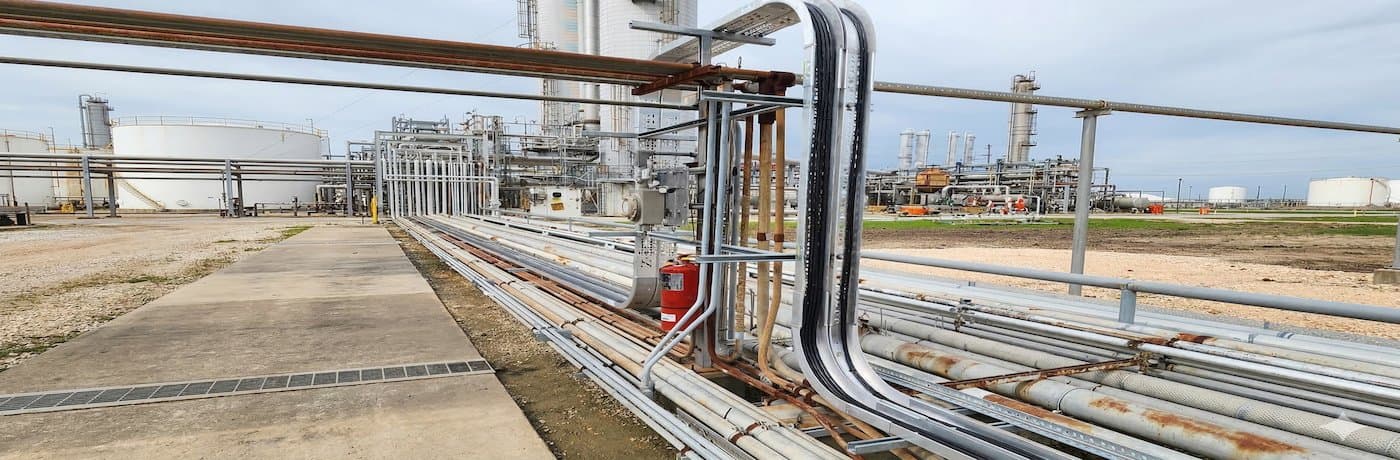
A Gulf Coast petrochemical facility replaced a planned ¾" rigid metal conduit instrument cable run with Snap Track channel cable tray. The run served a bank of pressure transmitters and flow instruments on a pipe rack. Both options were priced using the same routing path, same cable count, and same labor rate.
Snap Track cable tray
$14,683
$30.59 per foot installed
¾" RMC conduit
$45,493
$94.78 per foot installed
68% lower installed cost
$30,810 savings on a single 480-foot run
Labor rate reflects Gulf Coast all-in rate (base wage + benefits + overhead) for IBEW-staffed industrial construction, 2025 rates. Material costs include tray/conduit, fittings, supports, and hardware. Cable cost excluded — identical in both methods.
SUPPORT SPACING
18-foot spans vs 10-foot spans
Every support point costs money three ways: the hanger hardware itself, the structural steel or attachment point it mounts to, and the labor to install it. Cable tray spans up to 18 feet between supports at published load ratings. Conduit must be supported every 10 feet per NEC 344.30. On a 480-foot run, that difference is 21 fewer support points — 21 fewer hangers, 21 fewer beam clamps, 21 fewer installation cycles.
Cable tray
18 ft span
27 supports per 480 ft run
RMC conduit
10 ft span
48 supports per 480 ft run
NEC COMPLIANCE
Cable tray is a recognized NEC wiring method with a clear compliance path.
Cable tray is a recognized wiring method under NEC Article 392, with defined requirements for fill calculations, support spacing, grounding, and bonding. UL Classified channel cable tray provides the AHJ with third-party verification of compliance — a documented, inspection-ready path that streamlines project approvals.
UL Classified channel cable tray systems satisfy NEC 392 requirements for cable fill (392.22), support spacing (392.30), grounding and bonding (392.60), and installation (392.18). A UL Classification is important because it provides the AHJ with third-party confirmation that the tray system meets the dimensional, load, and material requirements of the NEC.
Not all cable tray is UL Classified. Open-top wire basket tray and some perforated trays are not classified and may face pushback from AHJs who require documented compliance. When selecting cable tray for instrument cable routing, confirm UL Classification before specifying.
FREQUENTLY ASKED QUESTIONS
Cable tray vs conduit: common questions
How much does cable tray cost compared to conduit for instrument cable routing?
In a documented 480-foot Gulf Coast installation, channel cable tray (Snap Track) cost $14,683 installed ($30.59/ft) versus $45,493 for ¾" rigid metal conduit ($94.78/ft) — a 68% reduction in total installed cost. The savings come from both lower labor (0.18 vs 0.40 man-hours per foot) and lower material cost.
What is the labor rate for cable tray installation vs conduit?
Channel cable tray installs at 0.18 man-hours per linear foot using push-pin assembly with no special tools. Rigid metal conduit ranges from 0.40 man-hours per foot (¾" RMC) to 0.56 man-hours per foot (1½" RMC) due to threading, bending, and coupling requirements at every joint.
Is cable tray NEC compliant for instrument cable?
Yes. Cable tray is a recognized wiring method under NEC Article 392. UL Classified channel cable tray systems satisfy NEC requirements for cable fill, support spacing, grounding, and bonding. Cable tray has been used for instrument cable routing in refineries, LNG facilities, and petrochemical plants for decades.
How far apart do cable tray supports need to be vs conduit supports?
Channel cable tray supports spans up to 18 feet between supports at published load ratings. Rigid metal conduit must be supported every 10 feet per NEC 344. On a 480-foot run, that means 27 supports for cable tray vs 48 for conduit — 44% fewer hangers, less structural steel, and less installation labor.
Related pages
Snap Track Cable Tray
Product specs, load data, and NEC fill tables.
ViewInstrument Cable Routing
How cable tray fits into a complete instrument loop.
ViewSnap Track Advisor
Interactive tool — select tray width, get fill calculations.
ViewOil & Gas Applications
Cable routing solutions for refinery and petrochemical.
ViewLNG Facilities
Instrument installation systems for LNG plants.
ViewComplete Instrument Loops
How every TechLine component works together.
View