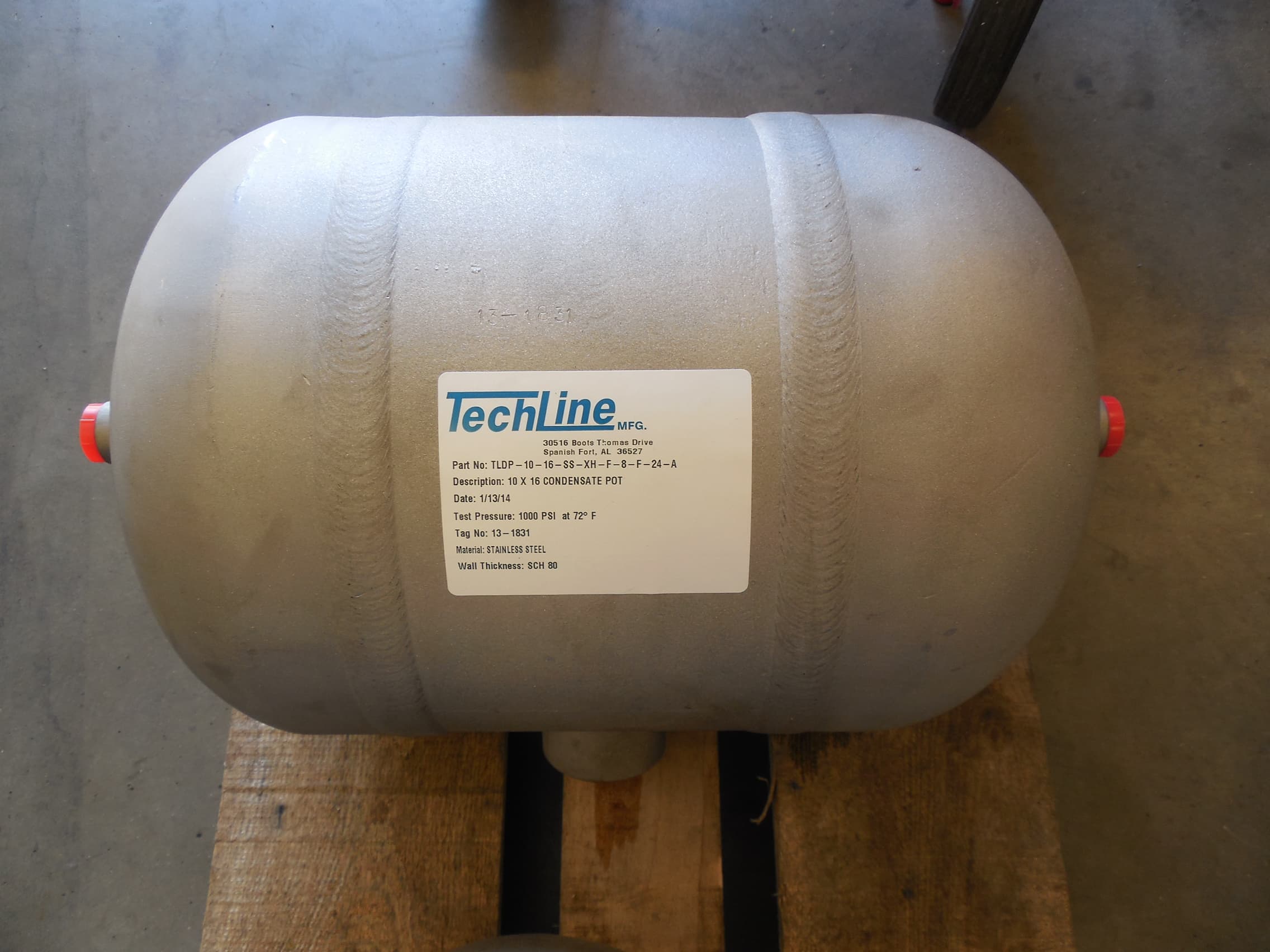
Condensate Chamber & Seal Pot Specification Guide
How to specify condensate chambers and seal pots for process plant instrument loops. ASME requirements, sizing, material selection by service condition, port configurations, and the distinction between chambers and seal pots.
ASME VIII
Fabrication Standard
7 Materials
CS to Hastelloy
7 Port Configs
A through G
UG-99
Hydro Tested
FUNDAMENTALS
Condensate chamber vs seal pot: same vessel, different function.
Both are pressure vessels that sit between the process line and the instrument. The difference is what's inside them and why. A condensate chamber uses process condensate to create a protective liquid column. A seal pot uses an inert fill fluid to create a barrier. The fabrication, ASME requirements, and physical construction are identical — the distinction is operational.
Condensate Chamber
Function
Maintains a liquid column between the process and the instrument
Typical Service
Steam, hot gas, condensing vapor
Fill Fluid
Process condensate (self-filling in steam service)
Refill
Self-maintaining in steam service
Seal Pot
Function
Creates a liquid seal barrier to isolate the instrument from process vapors or corrosive gases
Typical Service
Corrosive gas, toxic vapor, wet gas with entrained liquids
Fill Fluid
Inert fill fluid (glycol, silicone oil, or process-compatible liquid)
Refill
Requires initial fill and periodic verification
Both use vertical orientation — gravity maintains the liquid column or seal.
ASME REQUIREMENTS
What ASME compliance means for condensate chambers.
A condensate chamber is a pressure vessel. It connects directly to the process line and sees full process pressure. ASME Section VIII Division 1 governs the design, fabrication, and testing of unfired pressure vessels — including condensate chambers and seal pots regardless of size.
TechLine condensate chambers are manufactured under ASME Section IX qualified welding procedures with procedure and performance qualifications on file. Every chamber is hydrotested per ASME Section VIII Division 1, UG-99, and ships with a pressure test certificate. X-ray and dye-penetrant testing are available on request for critical service applications.
Not all condensate chambers on the market meet these standards. Some suppliers offer chambers fabricated from standard pipe fittings without qualified welding procedures, without hydrotesting, and without documentation. In a process plant environment where the AHJ expects ASME compliance for pressure-containing components, specifying “ASME Section VIII, hydrotested per UG-99, with pressure test certificate” eliminates ambiguity.
Specification language:
“ASME Section VIII Div 1 fabrication, Section IX qualified welding, hydrotested per UG-99. Pressure test certificate required.”
SIZING
Standard sizes and when to deviate.
The standard configuration — 3" pipe, 12" length, Schedule 80 — handles the majority of refinery and petrochemical DP transmitter applications. Deviate from standard when the service temperature, pressure, or port configuration demands it.
Standard. Covers most refinery and petrochemical DP transmitter applications.
Extended length for high-temperature service where more condensate volume provides better thermal protection.
Larger diameter for high-flow condensate or applications requiring a greater liquid reserve.
Compact applications where space is constrained or process connections are small.
Large-bore service. Less common — typically high-pressure, high-flow applications.
MATERIAL SELECTION
Match the chamber material to the process fluid and temperature.
Unlike instrument stands where the material matches the ambient environment, condensate chamber material must match the process fluid. The chamber is a wetted component — it sees full process pressure, temperature, and chemical exposure.
Carbon Steel
CS
General service, non-corrosive process fluids, steam under 750°F
304 Stainless Steel
SS
Moderate corrosion resistance, general chemical service
316 Stainless Steel
316SS
High corrosion environments, Gulf Coast outdoor, chloride-bearing process fluids
Chrome 11 (1.25Cr-0.5Mo)
P11
High temperature steam service to ~900°F — common in power generation
Chrome 22 (2.25Cr-1Mo)
P22
High temperature steam service to ~1050°F
Chrome 91 (9Cr-1Mo-V)
P91
Supercritical and ultra-supercritical steam to ~1100°F
Hastelloy
—
Severe corrosive service — sulfuric acid, hydrochloric acid, wet chlorine gas
Rule of thumb: match the condensate chamber material to the process piping material specification. If the process pipe is P11, the chamber should be P11.
PORT CONFIGURATIONS
Seven standard port configurations — A through G.
The port configuration determines how many connections the chamber has and where they're located. Configuration A (1 top, 1 bottom, 1 side drain) is the standard for most DP transmitter applications. Higher configurations add ports for redundant transmitters, calibration connections, or dual process connections.
1 top, 1 bottom, 1 side drain
Standard differential pressure transmitter — process on top, instrument on bottom, drain/vent on side.
1 top, 1 bottom, 2 side
DP transmitter with additional side connections for gauge or calibration.
2 top, 1 bottom
Dual top connections for process and vent, single bottom to instrument.
1 top, 2 bottom
Single process connection with dual instrument connections — redundant transmitter setup.
2 top, 2 bottom
Fully redundant — dual process and dual instrument connections.
Custom
Non-standard port locations per customer drawing. Specify exact positions and sizes.
Custom
Special configuration — contact TechLine engineering.
Part number example:
TLDP-3-12-316SS-XH-F-8-A
3" pipe, 12" length, 316 stainless steel, Schedule 80, Female NPT connections, ½" connection size, Configuration A. This is the standard stock configuration — ships immediately.
FREQUENTLY ASKED QUESTIONS
Condensate chamber specification: common questions.
What is the difference between a condensate chamber and a seal pot?
A condensate chamber maintains a liquid column from process condensate — typically in steam service where the chamber self-fills. A seal pot uses an inert fill fluid (glycol, silicone oil) to create a barrier isolating the instrument from corrosive gases or toxic vapors. Same vessel, different function.
What ASME certification is required for condensate chambers?
Condensate chambers should be manufactured under ASME Section IX qualified welding procedures and hydrotested per ASME Section VIII Division 1, UG-99. Every chamber should ship with a pressure test certificate. Specify these requirements explicitly to avoid receiving non-compliant chambers from low-cost suppliers.
What size condensate chamber do I need?
3" pipe diameter, 12" length, Schedule 80 covers most refinery and petrochemical DP transmitter applications. Use longer chambers (18"–24") in high-temperature service. Use larger diameters (4"–6") for high-flow condensate. The pipe diameter must accommodate your port configuration and connection sizes.
What material should I specify for a condensate chamber?
Match the chamber material to the process piping material specification. 316SS for Gulf Coast and petrochemical applications. Carbon steel for general non-corrosive service. Chrome alloys (P11, P22, P91) for high-temperature steam. Hastelloy for severe corrosive service.
Related Pages
Condensate Chambers & Seal Pots
Full product page with configurations and ordering.
ViewProcess Connection & Protection
How chambers fit into a complete instrument loop.
ViewComplete Instrument Loops
From process tap to junction box.
ViewDistribution Manifolds
Instrument air distribution for process plants.
ViewOil & Gas Applications
Instrument installation for refinery and petrochemical.
ViewPower Generation
High-temperature steam instrument systems.
View